Disclosure: This article is posted to inform readers and not to provide financial advice.
What is an Economic Review?
An economic review helps investors stay informed on the state of global and local markets, which can significantly influence investment decisions. This Quarterly Economic Review provides key insights on factors such as inflation, interest rates, asset classes, bonds, equities, as well as general economic growth and employment.
Q4 covers October, November, and December, and this article reflects on the key economic developments of 2024, considering both global market trends and South African headlines as the year came to a close.
Q4 covers October, November, and December, and this article reflects on the key economic developments of 2024, considering both global market trends and South African headlines as the year came to a close.
Global and Local Markets in Summary
Global Overview:
The fourth quarter of 2024 was marked by volatility, particularly in bond markets. U.S. economic resilience, combined with higher inflation, led to rising bond yields and a stronger U.S. dollar. A more hawkish tone from the Federal Reserve also dampened expectations for interest rate cuts, leaving markets subdued towards the end of the year. Despite these challenges, U.S. equities ended Q4 higher, though geopolitical tensions and inflation concerns continued to cloud investor sentiment.
Local Overview:
South Africa faced a mixed quarter. The rand remained relatively flat, while local equities experienced pressure, particularly in December, marking the third consecutive month of declines. While economic growth projections for 2025 remain positive, with KPMG forecasting 1.5% growth, challenges such as rising unemployment and slower consumption growth persist.
Global Economic Overview
Interest Rate Trends and Inflation:
Central banks worldwide continued to ease interest rates in Q4 2024. The Federal Reserve (which is the central banking system of the United States), reduced rates three times, including a substantial 50-basis-point cut in September, followed by smaller 25-basis-point reductions in November and December. Inflation in major economies like the U.S., Europe, and China continued to cool, which positively impacted investor sentiment.
Growth Prospects in Major Economies:
Growth prospects in the U.S. remained robust despite the Fed’s rate cuts, and the global inflation outlook showed signs of easing. Europe’s growth continued to be tepid, with inflation rates declining, which fueled hopes of economic stability. China’s economic policy easing, especially in the second half of the year, provided some relief, though economic growth remained sluggish. On the other hand, emerging markets (EM) faced significant challenges, with the MSCI Emerging Markets IMI (Investable Market Index) Index – a broad-based equity index designed to track the performance of emerging markets’ stocks – declining by 7.9%.
Ending off a year of elections:
The 2024 global election cycle saw notable political shifts, including far-right gains in Europe, a liberal opposition win in South Korea, and the UK’s Labour Party ousting the Conservatives. In India and South Africa, incumbent parties held power but with decreasing support.
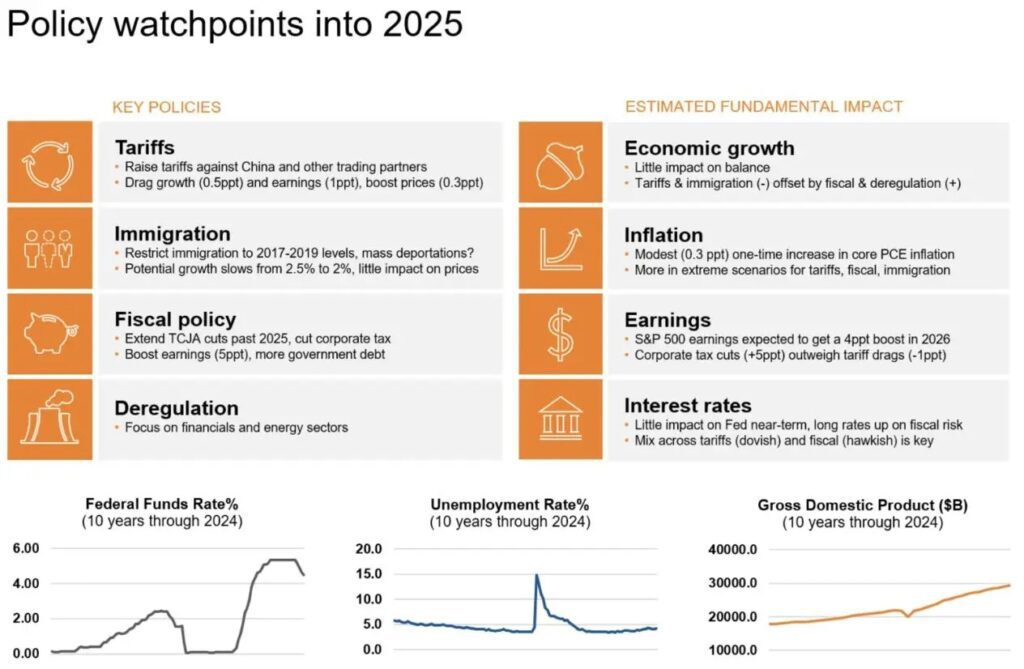
Perhaps one of the most significant political developments was Donald Trump regaining the U.S. presidency, raising concerns about the potential for more transactional trade and foreign policies under his administration – and creating uncertainty about the global economic outlook.
Perhaps one of the most significant political developments was Donald Trump regaining the U.S. presidency, raising concerns about the potential for more transactional trade and foreign policies under his administration – and creating uncertainty about the global economic outlook.
Market Performance: Equities, Bonds, and Commodities
Global Equities:
Global equities saw mixed results, with U.S. large-cap stocks outperforming other regions. The S&P 500 Index (a stock market index that tracks the performance of 500 large, publicly traded companies in the U.S.) posted strong returns, driven by big tech stocks. However, European and Chinese equities struggled, with European markets experiencing a sharp December sell-off. The MSCI All Country World Index, a global stock market index that tracks the performance of large and mid-cap stocks across 23 developed markets (DM) and 24 emerging markets (EM) countries, fell by 0.9% in Q4.
Bonds:
In the fourth quarter of 2024, global bond markets experienced varying performances. The World Government Bond Index (WGBI) – a benchmark index that tracks the performance of government bonds issued by developed market countries – reported a return of 0.96% for the year, influenced by slight declines in interest rates across major countries. The Bloomberg U.S. Aggregate Bond Index dropped by 3.1% in Q4, reducing its annual return to 1.3%.
Commodities:
Commodity markets were mixed. In Q4 2024, the Bloomberg Commodity Index (BCOM) – which is widely followed benchmark tracking commodities performance – saw a 0.45% loss, despite a 1.02% rise in December, and commodities as a whole were up 5.38% for the year. Energy commodities like oil faced fluctuations, while agricultural commodities like cocoa and coffee saw strong gains. Gold also performed well due to geopolitical concerns, while metals like copper struggled due to weaker demand, particularly from China.
Local Market Overview: South Africa
In South Africa, GDP expanded by 0.6% in the fourth quarter of 2024, following a 0.1% contraction in the previous quarter, with agriculture, forestry, and fishing leading the positive growth. Unemployment remains a challenge, sitting at 32.1% in December 2024.
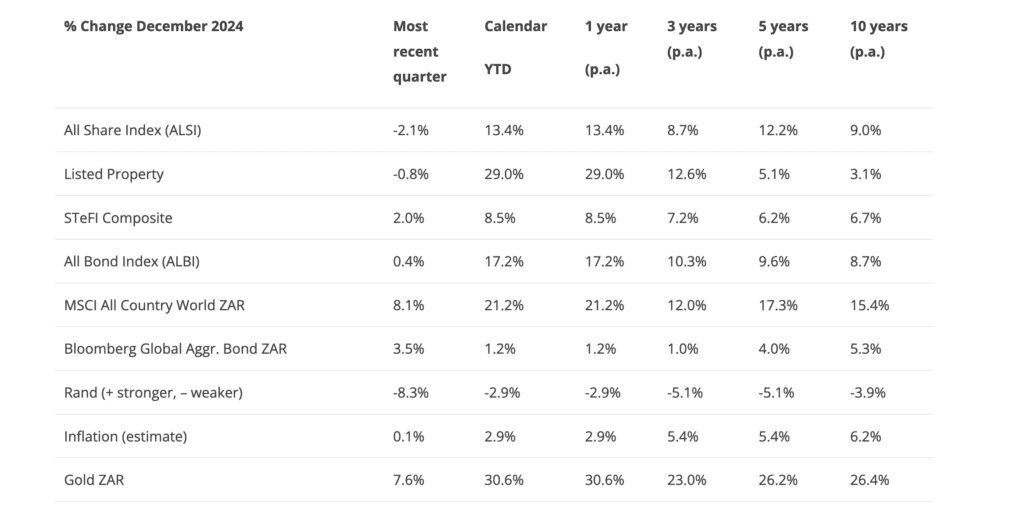
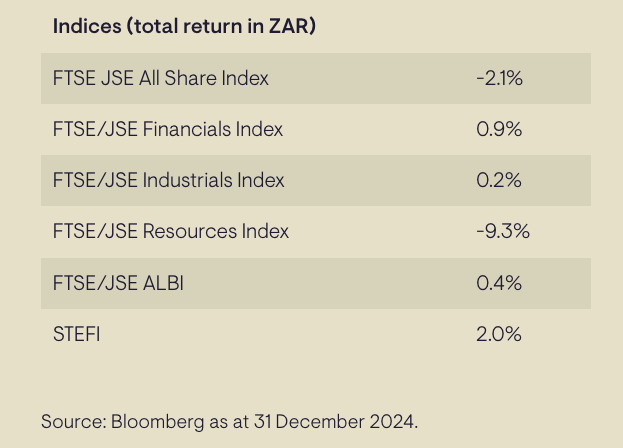
The South African Reserve Bank (SARB) cut the local repurchase rate twice during the year, reducing rates by 0.25% in both August and November. This helped ease consumer sentiment, though economic activity remained slow. The FTSE/JSE All Share Index – which tracks the performance of the largest companies listed on the Johannesburg Stock Exchange (JSE) in South Africa – was down by 2.1% in Q4, but it closed 2024 up by 13.4% after a strong performance earlier in the year.
In Q4 2024, South Africa’s commodity sector showed mixed performance, with gold maintaining its strong yearly gains despite a slight decline, while platinum and palladium fluctuated due to global demand. Coal exports continued to perform well, but higher oil prices added pressure on inflation, impacting both consumers and businesses.
The easing of loadshedding during the quarter positively impacted business confidence. On the political side, things continue to evolve with the Government of National Unity (GNU). Inflation in South Africa remained a concern but showed signs of stabilizing in Q4, in line with global trends. The SARB’s policy adjustments were aimed at ensuring inflation remained within target ranges.
The South African Reserve Bank (SARB) cut the local repurchase rate twice during the year, reducing rates by 0.25% in both August and November. This helped ease consumer sentiment, though economic activity remained slow. The FTSE/JSE All Share Index – which tracks the performance of the largest companies listed on the Johannesburg Stock Exchange (JSE) in South Africa – was down by 2.1% in Q4, but it closed 2024 up by 13.4% after a strong performance earlier in the year.
In Q4 2024, South Africa’s commodity sector showed mixed performance, with gold maintaining its strong yearly gains despite a slight decline, while platinum and palladium fluctuated due to global demand. Coal exports continued to perform well, but higher oil prices added pressure on inflation, impacting both consumers and businesses.
The easing of loadshedding during the quarter positively impacted business confidence. On the political side, things continue to evolve with the Government of National Unity (GNU). Inflation in South Africa remained a concern but showed signs of stabilizing in Q4, in line with global trends. The SARB’s policy adjustments were aimed at ensuring inflation remained within target ranges.
Conclusion: Reflecting on 2024 and Looking Ahead
Q4 2024 marked a volatile but relatively positive end to the year globally, with interest rate cuts and easing inflation fueling optimism. South Africa showed signs of recovery, especially in terms of business sentiment and financial market performance, though challenges like high unemployment and political uncertainties remain.
Looking ahead, global markets face a new set of challenges, from potential disruptions in supply chains to evolving geopolitical tensions. For South Africa, while the outlook is cautiously optimistic, growth will likely be slow.
Stay ahead of the curve in 2025. Contact TVC today for personalised financial advice and guidance on investing amidst a changing global landscape.
Looking ahead, global markets face a new set of challenges, from potential disruptions in supply chains to evolving geopolitical tensions. For South Africa, while the outlook is cautiously optimistic, growth will likely be slow.
Stay ahead of the curve in 2025. Contact TVC today for personalised financial advice and guidance on investing amidst a changing global landscape.