
It is one of the most common questions we are asked, and quite rightly so: “if I invest this money, how will it be taxed?” The honest answer is that it depends entirely on where you invest it. Each vehicle in the South African market carries its own tax treatment, its own timing, and its own restrictions on access. For investors sitting on substantial cash balances, understanding these differences is not a technicality, it is the difference between a portfolio that quietly compounds and one that quietly leaks.
In what follows we set out the tax characteristics of the six investment vehicles most commonly used by South African investors, together with a note on how easily each can be turned back into cash. The figures referenced reflect the position for the 2025/2026 tax year and are subject to legislative change.
In what follows we set out the tax characteristics of the six investment vehicles most commonly used by South African investors, together with a note on how easily each can be turned back into cash. The figures referenced reflect the position for the 2025/2026 tax year and are subject to legislative change.
1. Retirement Annuities
Tax on contributions: Highly favourable. Contributions are deductible against your taxable income up to 27.5% of the greater of your remuneration or taxable income, capped at R350,000 per tax year. Excess contributions are not lost, they are carried forward and may be deducted in later years, or used to reduce the tax on the lump sum at retirement.
Tax on growth inside the fund: None. Interest, dividends and capital gains accumulate entirely free of tax, a significant advantage over time.
Tax on withdrawal: At retirement (from age 55), one-third may be taken as a lump sum, with the first R550,000 of cumulative lump sums tax-free under the SARS retirement tax tables. The remaining two-thirds must be used to purchase a living or guaranteed annuity, the income from which is taxed at your marginal rate.
Two-pot system: Since 1 September 2024, new contributions are split between a savings pot (one-third, accessible once per tax year and taxed at marginal rate) and a retirement pot (two-thirds, preserved until retirement). Funds accumulated before that date sit in a vested pot under the old rules.
Unique features: Retirement annuities sit outside your estate for executor’s fees, are protected from creditors, and are generally not subject to estate duty when paid to a dependant. They remain one of the most tax-efficient long-term vehicles available.
Liquidity: Very low. Beyond the limited annual access via the savings pot, the bulk of the investment is locked until age 55.
Tax on growth inside the fund: None. Interest, dividends and capital gains accumulate entirely free of tax, a significant advantage over time.
Tax on withdrawal: At retirement (from age 55), one-third may be taken as a lump sum, with the first R550,000 of cumulative lump sums tax-free under the SARS retirement tax tables. The remaining two-thirds must be used to purchase a living or guaranteed annuity, the income from which is taxed at your marginal rate.
Two-pot system: Since 1 September 2024, new contributions are split between a savings pot (one-third, accessible once per tax year and taxed at marginal rate) and a retirement pot (two-thirds, preserved until retirement). Funds accumulated before that date sit in a vested pot under the old rules.
Unique features: Retirement annuities sit outside your estate for executor’s fees, are protected from creditors, and are generally not subject to estate duty when paid to a dependant. They remain one of the most tax-efficient long-term vehicles available.
Liquidity: Very low. Beyond the limited annual access via the savings pot, the bulk of the investment is locked until age 55.
2. Tax-Free Investments
Tax on contributions: Contributions are not deductible, but the limits are strict: R46,000 per tax year and R500,000 over your lifetime. Over-contributions attract a punitive 40% penalty on the excess.
Tax on growth: None. All interest, dividends (local and foreign) and capital gains earned inside a tax-free investment are entirely free of tax, the only true zero-tax wrapper available to the South African investor.
Tax on withdrawal: None. Withdrawals are tax-free at any age, for any reason.
Unique features: The benefit is small in the early years and significant in the later ones. A maximum-funded tax-free investment held for several decades can comfortably outgrow the lifetime contribution cap many times over, every cent of which sits outside SARS’ reach. Note that withdrawals do not restore your contribution room: once contributed, that capacity is used.
Liquidity: High. Funds can be accessed at any time, although doing so undermines the long-term value of the wrapper.
Tax on growth: None. All interest, dividends (local and foreign) and capital gains earned inside a tax-free investment are entirely free of tax, the only true zero-tax wrapper available to the South African investor.
Tax on withdrawal: None. Withdrawals are tax-free at any age, for any reason.
Unique features: The benefit is small in the early years and significant in the later ones. A maximum-funded tax-free investment held for several decades can comfortably outgrow the lifetime contribution cap many times over, every cent of which sits outside SARS’ reach. Note that withdrawals do not restore your contribution room: once contributed, that capacity is used.
Liquidity: High. Funds can be accessed at any time, although doing so undermines the long-term value of the wrapper.
3. Unit Trusts
Tax on contributions: None. Contributions are made from after-tax money.
Tax on growth: Unit trusts are taxed in the investor’s hands as income arises:
• Interest: taxed at your marginal rate, with an annual exemption of R23,800 (under 65) or R34,500 (65 and over).
• Local dividends: subject to a 20% Dividends Withholding Tax, deducted at source.
• Foreign dividends: taxed at your marginal rate, with a partial exemption mechanism that produces an effective rate of around 20% for top-bracket taxpayers.
• Capital gains: triggered only when units are sold or switched between funds. 40% of the gain is included in your taxable income, producing a maximum effective rate of 18%. An annual R40,000 capital gain exclusion applies.
Unique features: Unit trusts are the workhorse of most investment portfolios — transparent, well-regulated and available across every asset class. The tax is manageable, particularly the capital gains component, which sits well below the marginal income tax rate.
Liquidity: High. Most unit trusts settle within two to three business days.
Tax on growth: Unit trusts are taxed in the investor’s hands as income arises:
• Interest: taxed at your marginal rate, with an annual exemption of R23,800 (under 65) or R34,500 (65 and over).
• Local dividends: subject to a 20% Dividends Withholding Tax, deducted at source.
• Foreign dividends: taxed at your marginal rate, with a partial exemption mechanism that produces an effective rate of around 20% for top-bracket taxpayers.
• Capital gains: triggered only when units are sold or switched between funds. 40% of the gain is included in your taxable income, producing a maximum effective rate of 18%. An annual R40,000 capital gain exclusion applies.
Unique features: Unit trusts are the workhorse of most investment portfolios — transparent, well-regulated and available across every asset class. The tax is manageable, particularly the capital gains component, which sits well below the marginal income tax rate.
Liquidity: High. Most unit trusts settle within two to three business days.
4. Endowments
Tax on contributions: None. Contributions are made from after-tax money.
Tax on growth: Taxed inside the policy under the “Four Funds” approach. For an individual policyholder, interest and foreign dividends are taxed at a flat 30%, and capital gains at an effective rate of 12%. Local dividends remain subject to the 20% Dividends Withholding Tax. No tax is payable in the investor’s hands on these returns.
Tax on withdrawal: None. Proceeds at maturity, surrender or death are paid to the investor or nominated beneficiary free of further personal tax.
Unique features: Endowments are designed for investors whose marginal tax rate exceeds 30% — typically those in the top brackets — because the flat policyholder rate is lower than what they would pay personally. They are also a useful estate planning tool: a nominated beneficiary receives the proceeds directly, bypassing the executor’s process and the associated fees.
Liquidity: Restricted in the first five years (one withdrawal of contributions plus 5% growth, and one loan), then fully accessible thereafter.
Tax on growth: Taxed inside the policy under the “Four Funds” approach. For an individual policyholder, interest and foreign dividends are taxed at a flat 30%, and capital gains at an effective rate of 12%. Local dividends remain subject to the 20% Dividends Withholding Tax. No tax is payable in the investor’s hands on these returns.
Tax on withdrawal: None. Proceeds at maturity, surrender or death are paid to the investor or nominated beneficiary free of further personal tax.
Unique features: Endowments are designed for investors whose marginal tax rate exceeds 30% — typically those in the top brackets — because the flat policyholder rate is lower than what they would pay personally. They are also a useful estate planning tool: a nominated beneficiary receives the proceeds directly, bypassing the executor’s process and the associated fees.
Liquidity: Restricted in the first five years (one withdrawal of contributions plus 5% growth, and one loan), then fully accessible thereafter.
5. Cash in a Notice Deposit Account
Tax on contributions: None. Deposits are made from after-tax money.
Tax on growth: Interest is taxed at your marginal rate, which for high-income earners is 45%. The annual interest exemption of R23,800 (under 65) or R34,500 (65 and over) is helpful but quickly exhausted on substantial balances — at current rates, a deposit of around R260,000 already produces enough interest to use up the exemption for a younger investor.
Tax on withdrawal: None on the capital. Interest is taxed in the year it accrues, regardless of whether it is withdrawn or rolled forward.
Unique features: Capital is preserved and the return is predictable. The cost, however, is that all of the growth is taxed at the harshest rate available and that returns rarely keep pace with inflation after tax, particularly for top-bracket taxpayers.
Liquidity: Dependent on the notice period, typically 7, 32, 60 or 90 days. Funds cannot be accessed without surrendering some or all of the interest if withdrawn before notice is given.
Tax on growth: Interest is taxed at your marginal rate, which for high-income earners is 45%. The annual interest exemption of R23,800 (under 65) or R34,500 (65 and over) is helpful but quickly exhausted on substantial balances — at current rates, a deposit of around R260,000 already produces enough interest to use up the exemption for a younger investor.
Tax on withdrawal: None on the capital. Interest is taxed in the year it accrues, regardless of whether it is withdrawn or rolled forward.
Unique features: Capital is preserved and the return is predictable. The cost, however, is that all of the growth is taxed at the harshest rate available and that returns rarely keep pace with inflation after tax, particularly for top-bracket taxpayers.
Liquidity: Dependent on the notice period, typically 7, 32, 60 or 90 days. Funds cannot be accessed without surrendering some or all of the interest if withdrawn before notice is given.
6. Direct Property
Tax on acquisition: Transfer duty applies on a sliding scale (no duty below R1.1 million; 13% on the portion above R12 million). If purchased from a VAT vendor, VAT applies instead.
Tax on rental income: Net rental, after deductible expenses such as rates, levies, agent’s commission, maintenance, insurance and interest on a bond, is taxed at your marginal rate.
Tax on disposal: Capital Gains Tax applies, with 40% of the gain included in taxable income and a maximum effective rate of 18%. The R2 million primary residence exclusion does not apply to investment property. Section 13sex offers a 5% annual depreciation allowance for qualifying new residential developments where five or more units are owned.
Unique features: Property offers tangible diversification, the potential for both income and capital growth, and meaningful tax deductions against rental income. The trade-off is concentration risk, ongoing management, and substantial transaction costs at both ends of the holding period.
Liquidity: Very low. A sale typically takes several months from listing to transfer, and the costs of entry and exit, transfer duty, conveyancing, agent’s commission, are significant.
Tax on rental income: Net rental, after deductible expenses such as rates, levies, agent’s commission, maintenance, insurance and interest on a bond, is taxed at your marginal rate.
Tax on disposal: Capital Gains Tax applies, with 40% of the gain included in taxable income and a maximum effective rate of 18%. The R2 million primary residence exclusion does not apply to investment property. Section 13sex offers a 5% annual depreciation allowance for qualifying new residential developments where five or more units are owned.
Unique features: Property offers tangible diversification, the potential for both income and capital growth, and meaningful tax deductions against rental income. The trade-off is concentration risk, ongoing management, and substantial transaction costs at both ends of the holding period.
Liquidity: Very low. A sale typically takes several months from listing to transfer, and the costs of entry and exit, transfer duty, conveyancing, agent’s commission, are significant.
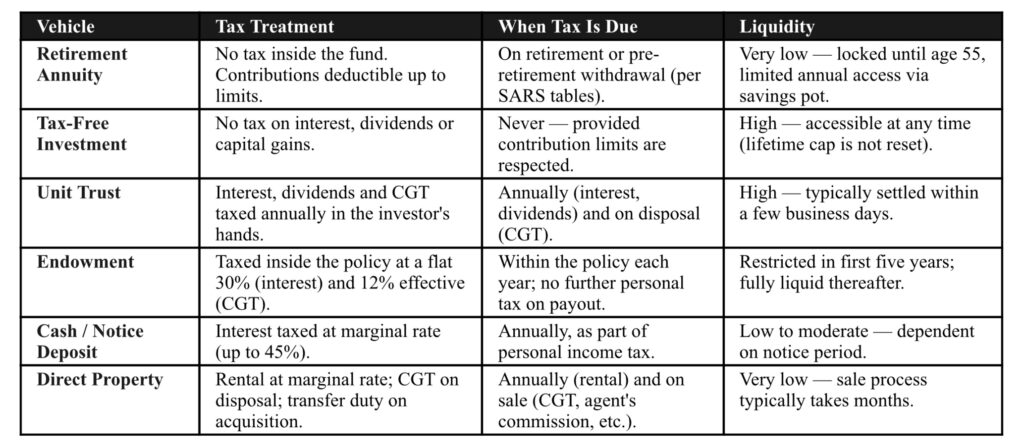
Tax & Liquidity Summary
A Closing Thought
No single vehicle is the right answer for every investor, nor is any one of them the wrong answer. The art lies in combining them.
A well-constructed portfolio typically uses several wrappers in parallel: a retirement annuity for the long-dated, tax-deductible growth; a tax-free investment to capture compounding entirely outside the tax net; unit trusts for flexibility and access; and an endowment or property where the marginal tax rate makes either compelling. Cash plays a role too, but as a short-term home for liquidity, not a long-term store of wealth.
Whether your cash currently sits in a notice deposit, a money market account, or simply in your transactional account, the question worth asking is not “what is it earning?” but “what is it earning after tax, after inflation, and against the opportunity cost of investing it properly?” More often than not, the answer warrants a conversation.
A well-constructed portfolio typically uses several wrappers in parallel: a retirement annuity for the long-dated, tax-deductible growth; a tax-free investment to capture compounding entirely outside the tax net; unit trusts for flexibility and access; and an endowment or property where the marginal tax rate makes either compelling. Cash plays a role too, but as a short-term home for liquidity, not a long-term store of wealth.
Whether your cash currently sits in a notice deposit, a money market account, or simply in your transactional account, the question worth asking is not “what is it earning?” but “what is it earning after tax, after inflation, and against the opportunity cost of investing it properly?” More often than not, the answer warrants a conversation.