When you sit across from a financial adviser, you are placing a great deal of trust in their knowledge. Tax law changes. Markets shift. Retirement and estate rules are revised. The advice that was sound three years ago may no longer be the advice you need today.
That is precisely the problem Continuous Professional Development (CPD) is designed to solve. It is the regulatory mechanism that ensures the people advising you keep their knowledge current, year after year. At TVC, we treat it not as a box to tick, but as a measure of how seriously we take the responsibility you place in us.
That is precisely the problem Continuous Professional Development (CPD) is designed to solve. It is the regulatory mechanism that ensures the people advising you keep their knowledge current, year after year. At TVC, we treat it not as a box to tick, but as a measure of how seriously we take the responsibility you place in us.
What The Regulator Requires
In South Africa, financial advisers operate under the Financial Advisory and Intermediary Services (FAIS) Act, regulated by the Financial Sector Conduct Authority (FSCA). Under Board Notice 194 of 2017, advisers authorised across more than one class of business must complete a minimum of 18 CPD hours in every cycle, the cycle running from 1 June to 31 May each year. At least 3 of those hours must focus on ethics and practice standards.
These hours cannot simply be claimed. They must come from activities accredited by a recognised professional body, and they must be verifiable, meaning there is documented proof that the adviser attended and, where applicable, passed an assessment.
These hours cannot simply be claimed. They must come from activities accredited by a recognised professional body, and they must be verifiable, meaning there is documented proof that the adviser attended and, where applicable, passed an assessment.
A Higher Bar: The CFP® Professional
Both of our advisers, Ronnie and Justin, are members of the Financial Planning Institute of Southern Africa (FPI) and carry the CERTIFIED FINANCIAL PLANNER® designation, the global benchmark for financial planning professionalism.
The FPI sets a considerably higher standard than the regulatory floor. A CFP® professional must complete 35 CPD hours per cycle, of which at least 20 must be verifiable, structured across three areas:
The FPI sets a considerably higher standard than the regulatory floor. A CFP® professional must complete 35 CPD hours per cycle, of which at least 20 must be verifiable, structured across three areas:
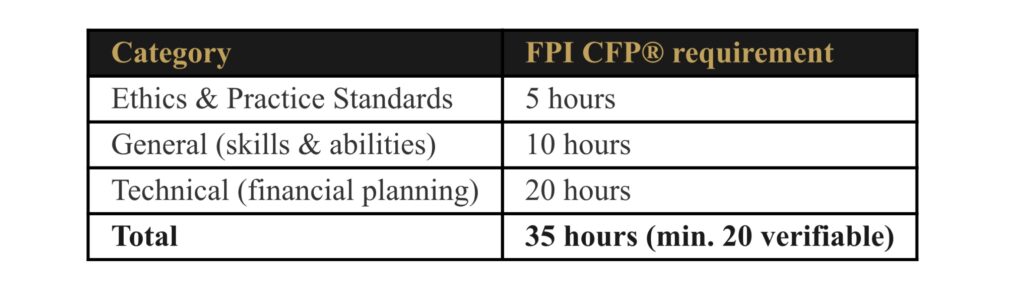
So the picture is layered: 18 hours to satisfy the regulator, and 35 hours to maintain CFP® standing. The CFP® standard comfortably exceeds the legal minimum.
What Our Advisers Actually Achieved
For the current cycle, 1 June 2025 to 31 May 2026, both advisers exceeded not only the FSCA minimum, but the more demanding FPI CFP® standard.
Justin completed 76 CPD hours against a goal of 35, with 76verifiable hours against a requirement of 20. Ronnie completed 43 CPD hours against the same 35-hour goal, with 43 verifiable hours against the 20 required, more than double the CFP® standard and over four times the regulatory minimum.
Justin completed 76 CPD hours against a goal of 35, with 76verifiable hours against a requirement of 20. Ronnie completed 43 CPD hours against the same 35-hour goal, with 43 verifiable hours against the 20 required, more than double the CFP® standard and over four times the regulatory minimum.


These are not numbers we share to impress. We share them because they answer a fair question every client is entitled to ask: is the person advising me genuinely keeping up?
Why It Matters To You
CPD is easy to dismiss as administrative. But its real value sits in the advice itself. Hours spent on the latest tax changes mean your retirement contributions are structured against current rules. Hours on technical planning mean your estate and risk cover reflect how the law actually works today. Hours on ethics mean the advice is given in your interest, measured against a professional code.
An adviser who exceeds their CPD obligations is, quite simply, an adviser who has done the reading so that you do not have to.
If you would like to discuss how recent changes might affect your own plan, we would welcome the conversation.
An adviser who exceeds their CPD obligations is, quite simply, an adviser who has done the reading so that you do not have to.
If you would like to discuss how recent changes might affect your own plan, we would welcome the conversation.